The Ultimate Guide For Peptides & Payment Processing
So, you’ve decided to enter the world of wellness, longevity, and cutting-edge bio-hacking. You’ve sourced top-tier products, built a beautiful website, and your marketing strategy is so sharp it could cut glass. You’re ready to help fitness enthusiasts, research labs, or wellness seekers get their hands on high-quality amino acid chains.
But then, you try to plug in a standard credit card portal, and bam—your merchant account is shut down faster than a gym on New Year's Day afternoon.
Welcome to the complex world of peptides and payment processing.
If you’ve spent any time trying to launch or scale an online store in this niche, you already know that traditional financial institutions treat the word "peptide" like it’s radioactive material. But don't close your laptop in frustration just yet. Navigating peptides and payment processing doesn't require a PhD in advanced finance or a magic wand. It requires a solid understanding of why the banking system is terrified of these tiny molecular chains, and how you can position your business to secure stable, reliable, and long-term financial infrastructure.
In this definitive guide, we will break down everything you need to know about peptides & payment processing, why traditional merchant providers turn their backs on this lucrative industry, and how you can build a compliant merchant account that keeps your revenue flowing smoothly.
The Great Disconnect – Why Peptides & Payment Processing Are At Odds
To solve a problem, you first have to understand why it exists. On paper, your business is perfectly legal, highly professional, and fulfilling a massive market demand. So, why does mentioning peptides and payment processing to a standard commercial banker make them look like they’ve just seen a ghost?
The issue comes down to risk classification. In the financial sector, businesses are split into two categories: low-risk and high-risk. Traditional payment aggregators love low-risk businesses—think of an online boutique selling hand-knitted dog sweaters or a local coffee shop. These businesses have predictable supply chains, minimal regulatory oversight, and incredibly low rates of customer disputes.
On the other hand, peptides and payment processing falls squarely into the ultra-high-risk category.
Banks and credit card networks do not view your business through the lens of wellness or scientific advancement. Instead, they look at you through a lens of potential legal liabilities, shifting federal regulations, and financial chargebacks. When a traditional processor encounters peptides and payment processing, their automated risk algorithms instantly trigger a red flag, leading to frozen funds, terminated accounts, and a spot on the infamous TMF (Terminated Merchant File) list.
Understanding the mechanics of peptides and payment processing means recognizing that you aren't just selling a product; you are managing a highly scrutinized financial asset class.
The Regulatory Quagmire Impacting Peptides & Payment Processing
To truly master peptides and payment processing, you have to understand the regulatory tightrope that your merchant account underwriters walk every single day. Government health agencies across the globe are constantly updating their stances on cosmetic, research, and therapeutic compounds.
Because peptides sit in a grey area between dietary supplements, research chemicals, and prescription pharmaceuticals, underwriters face a moving target.
The Underwriter’s Worst Nightmare
When an insurance or banking underwriter reviews an application for peptides and payment processing, they ask themselves several terrifying questions:
Is this merchant selling products for human consumption without proper approval?
Are these items labeled strictly as "research chemicals," and if so, does the website layout contradict that claim?
Could a sudden regulatory ban turn this merchant’s entire inventory into contraband overnight?
If the answer to any of these questions is a vague "maybe," traditional financial institutions will decline the application. This is why securing dedicated peptides and payment processing is vastly different from setting up a standard e-commerce store. You cannot simply check a box and start accepting payments; you must actively prove your compliance to a specialized high-risk banking partner.
Why Traditional Processors Say "No" to Peptides & Payment Processing
It’s a story we hear every single week: a brilliant entrepreneur sets up an online shop, hooks up a standard off-the-shelf payment gateway, processes $10,000 in their first week, and celebrates. On week two, they receive a cold, automated email stating their account has been closed for violating terms of service, and their hard-earned money will be held for 180 days.
Why does this happen so consistently in the world of peptides and payment processing?
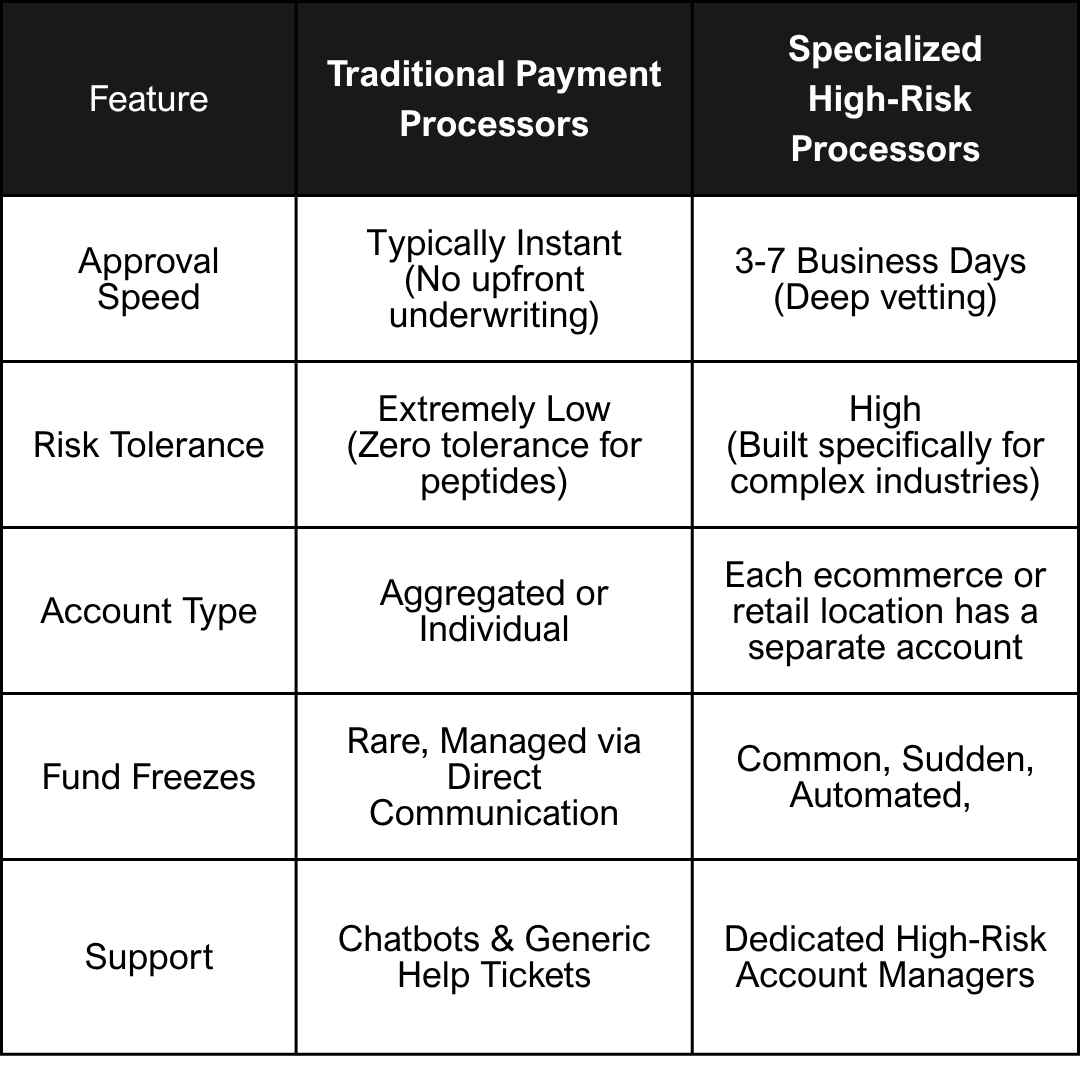
Traditional payment aggregators do not perform underwriting when you sign up. They let anyone open an account. However, they use automated software to scan your website text, transaction descriptions, and buyer patterns after you start making sales. The moment their system spots words associated with peptides and payment processing, your account is immediately flagged for review, and almost always shut down.
To survive long-term, you must bypass these consumer-grade platforms entirely and secure dedicated, high-risk peptides and payment processing infrastructure from day one.
Warning: If you a payment processor catches you doing business that they do not support (i.e. Peptides on a low-risk payment processing solution), you risk being shut down by the low-risk payment processor and possibly being put on the TMF (Terminated Merchant File or Match List). This could affect your EIN, ownership's Social Security # AND anyone's SS# associated with the owner's (think a spouse's on a joint tax return), for up to 7 years. Please check our other blogs about the TMF list and the consequences.
The Role of Chargebacks in Peptides & Payment Processing
Let's talk about the elephant in the room: chargebacks. In the world of high-risk merchant services, a chargeback is the ultimate metric of doom. A chargeback occurs when a customer calls their bank to dispute a charge rather than asking the merchant for a refund.
For businesses navigating peptides and payment processing, chargebacks happen far more frequently than they do for standard e-commerce shops. But why?
The Psychology of the Wellness Buyer:
Customers purchasing items in the wellness, fitness, and research spaces often expect immediate, miraculous results. If a product doesn't make them feel like a superhero within two weeks, or if they experience minor buyer's remorse after looking at their bank statement, their first instinct might be to claim "unauthorized purchase" to their credit card company.
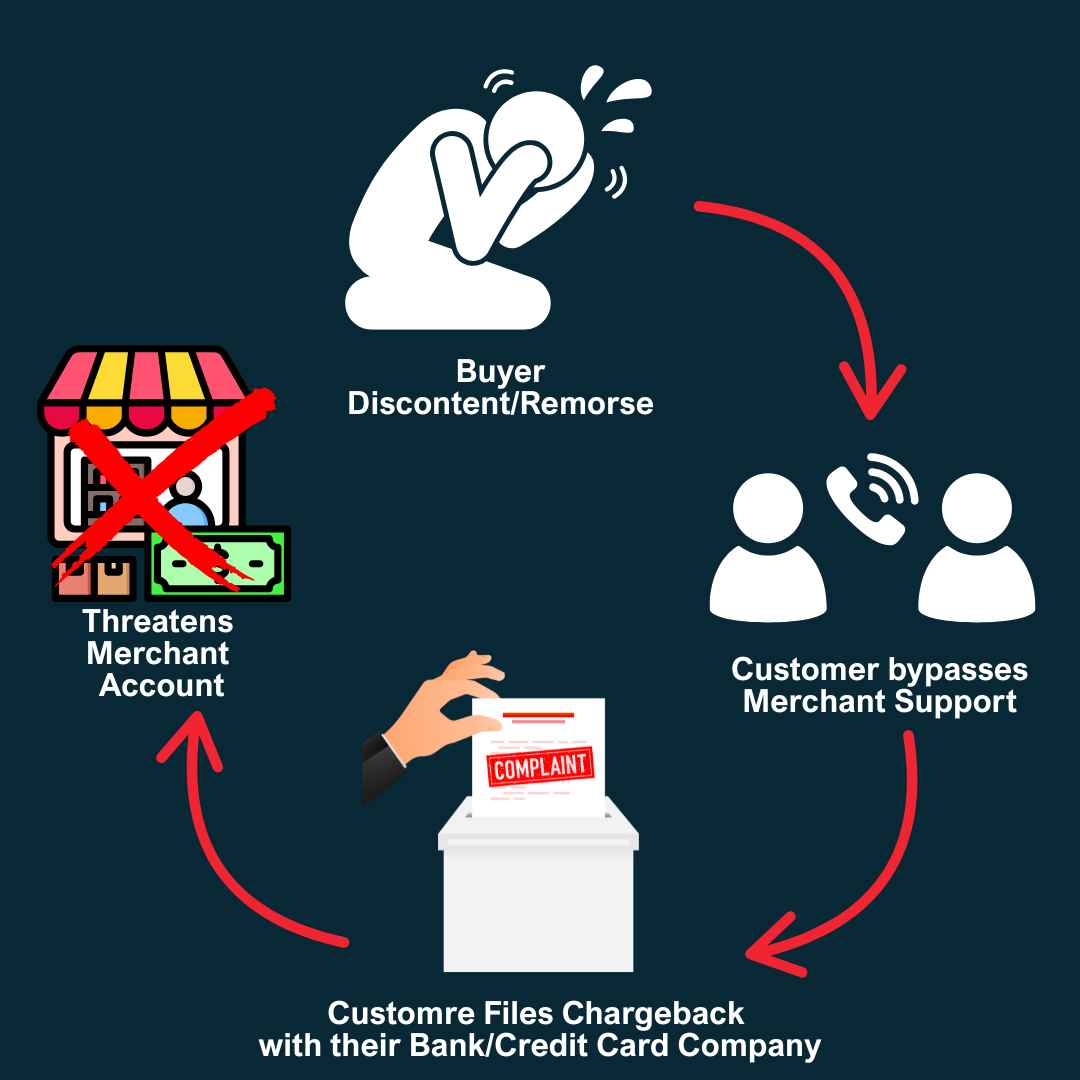
Furthermore, the price points for these products are typically much higher than average retail goods. High transaction values mean that when a chargeback does occur, it hits the payment ecosystem hard. Credit card networks monitor merchant chargeback ratios like hawks. If your chargeback rate climbs above 1%, your ability to maintain stable peptides and payment processing is put in severe jeopardy.
Working with a processor that specializes in peptides and payment processing gives you access to advanced chargeback mitigation tools, alert systems, and real-time disputes to stop these threats before they destroy your merchant processing relationship.
How to Prepare Your Website for Peptides & Payment Processing Underwriting
Securing approval for peptides and payment processing is very much like auditioning for a prestigious role or applying for a high-security mortgage. The bank is going to look under every digital rug and behind every virtual curtain.
To ensure your application doesn't get tossed into the rejection pile, you must optimize your website compliance before applying for peptides and payment processing.
The Ultimate Website Compliance Checklist
Clear Disclaimers: If you are selling research peptides, your website must clearly, boldly, and unambiguously state that the products are intended for laboratory research use only and not for human consumption.
FDA Disclaimer: For an FDA disclaimer that should appear on the footer of each page, please check with us. We have a checklist, disclaimers, etc to help you when we set you up.
LegitScript Certification: The underwriting provider will require you to have a LegitScript Certification to provide the payment processor. (We can help set this up for you and actually have a solution that gives a significant discount for this certification.)
Terms and Conditions: You must have an easily accessible, comprehensive Terms of Service page that outlines purchasing requirements, legal age restrictions, and intended use clauses.
Visible Refund Policy: Underwriters hate hidden fees and strict "no refunds under any circumstance" rules. Provide a clear, fair, and professional return and refund policy to prove you care about customer satisfaction.
Secure Checkout Architecture: Ensure your site uses up-to-date SSL encryption, displays secure checkout badges, and has a professional domain name (no sketchy, free-hosted subdomains).
Accurate Product Descriptions: Avoid making grandiose, unverified health claims. Stating that a compound will "cure all ailments and halt aging entirely" is a surefire way to have your peptides and payment processing application rejected instantly.
By auditing your website against these strict standards, you show high-risk underwriters that you are a serious, legitimate merchant who respects the regulatory boundaries surrounding peptides and payment processing.
The Step-by-Step Guide to Securing a Dedicated High-Risk Account
Once your website is perfectly polished and fully compliant, it’s time to actually apply for your dedicated high-risk merchant account. Navigating the application process for peptides and payment processing requires preparation, patience, and absolute transparency.
Here is the exact step-by-step roadmap to getting your account approved:
Step 1: Gather Your Corporate Documentation
High-risk underwriters do not operating on handshakes and good vibes. They need paper. Before applying for peptides and payment processing, ensure you have the following documents perfectly organized in a digital folder:
Articles of Incorporation or LLC Formation Documents
An Employer Identification Number (EIN) confirmation letter from the IRS
A government-issued ID for all principal business owners (drivers license or passport)
A pre-printed voided check or an official bank letter verifying your business checking account
Pictures of:
Your inventory
The inside of your business
The outside of your business
If you're utilizing a fulfillment company, a copy of the contract
LegitScript Certification
3 months most recent business bank statements
3 months most recent payment processing statements (if applicable. If they are seeing deposits from a payment provider into your bank account, they will want to see the corresponding statements).
The following information for anyone who owns more than 25% of the company:
Name
Colored copy of the front and back of your driver's license
Social Security Number
Home Phone
Mobile Phone
Email
Step 2: Organize Your Financial History
If you are an established business moving away from an unstable processor, you will need to provide 3 to 6 months of your most recent payment processing statements. These statements must show your total sales volume, transaction counts, and historical chargeback ratios. If you are a brand-new startup looking for your first taste of peptides and payment processing, you will need to provide your personal bank statements to demonstrate financial stability and responsibility.
Step 3: Choose the Right High-Risk Merchant Service Provider
Do not waste your time applying to standard commercial banks. Look for a financial services company that explicitly understands, welcomes, and specializes in peptides and payment processing. A specialized partner will know how to package your application so that it appeals directly to high-risk backing banks, maximizing your chances of a smooth approval.
Step 4: Be Prepared
Make sure you're asking the right questions when you're asking your merchant processor questions. Ask about fees. There will be some. They will be higher than typical low-risk merchant processing as well. Master Card and Visa will typically require you to register as a "high-risk" industry. This will cost about $1,900 per year (as of 07/2026). Then the Legit Script Certification can cost another $2-6k per year. (The supplier we typically start off with has an agreement with Legit Script and actually offers a significant discount if you put the payment processing and Legit Script Certification through them.)
Most payment processors that you would contact? Do NOT have experience in the high-risk markets. They also don't have more than one solution. We actually have 7 different suppliers that we work with BECAUSE we work with high-risk markets. 4 of them provide solutions to the peptide markets. This is what we're good at. If this is your line of business? We'd LOVE to work with you.
Spotting the Red Flags in High-Risk Merchant Agreements
Because the market for peptides and payment processing is notoriously difficult to navigate, some predatory providers take advantage of desperate merchants. When reviewing a merchant agreement for high-risk credit card processing, you must keep your eyes wide open and look out for hidden traps.
Beware of Excessive Rolling Reserves
It is incredibly common for high-risk backing banks to implement a "rolling reserve" on accounts processing high-risk goods. A rolling reserve means the bank holds a small percentage of your daily sales (usually 5% to 10%) for a set period (usually 180 days) to protect against future chargebacks.
While a rolling reserve is a standard practice in peptides and payment processing, you should run away from providers demanding outrageous terms like a 20% upfront reserve or an indefinite hold on all your working capital without clear, logical justification.
Currently, the solutions we lead with do NOT ask for a reserve typically. It has been known to happen but it's rare.
Watch Out for Outrageous Termination Fees
Some providers try to lock you into multi-year contracts with massive, liquidated damages or early termination fees. If a provider tries to force a three-year contract with a $5,000 exit penalty onto your business, they probably know their customer service is terrible. High-quality peptides and payment processing partners rely on excellent service and fair terms to keep your business, not aggressive legal handcuffs.
The providers we start with are currently not requiring a termination fee. (We hate them too). Not all providers allow us to do that. If your application doesn't work with our first two suppliers that support the peptide market...rare..you MIGHT have to have a termination fee with a contract. We would always tell you in advance.
The Technical Architecture of High-Risk Payment Gateways
Getting approved for a merchant account is only half the battle; you also have to connect that account to your e-commerce platform. When handling peptides and payment processing, your standard shopping cart integration needs to connect to a specialized high-risk payment gateway.
A high-risk gateway acts as the secure bridge between your customer's web browser and your dedicated high-risk banking network. When dealing with peptides and payment processing, your gateway needs to be robust, secure, and packed with advanced features. Look for a gateway solution that offers:
Load Balancing: The ability to route transactions across multiple merchant accounts to prevent over-saturation and optimize your volume limits.
Advanced Fraud Filters: Tools that analyze IP addresses, device fingerprints, and buying patterns to block fraudulent transactions before they turn into chargebacks.
Tokenization: Securely storing customer payment details for recurring subscriptions or seamless future purchases without compromising sensitive data security.
Integrating the right gateway infrastructure ensures that your day-to-day peptides and payment processing flows effortlessly behind the scenes, allowing you to focus on product development and marketing rather than technical troubleshooting.
We offer several gateways that will support this industry. Just let us know you're in need.
Best Practices for Maintaining Your Peptide Merchant Account Long-Term
Congratulations! Your website is compliant, your documentation was flawless, you avoided the sketchy providers, and your dedicated high-risk peptides and payment processing account is officially active. You are processing sales, scaling your business, and watching your revenue grow.
Now comes the most important part: keeping that account open.
Securing high-risk payment processing is tough but losing it because of sloppy operational habits is heartbreaking. To maintain an excellent relationship with your backing bank, implement these long-term survival strategies immediately.
Provide World-Class Customer Support
The absolute best weapon against chargebacks is an incredibly responsive customer service team. If a buyer is confused about their order, has a question about shipping speeds, or wants a refund, they should be able to reach a live human via email, chat, or phone instantly. If your support lines are a ghost town, that customer will skip right past you and call their bank, dealing a direct blow to your peptides and payment processing health.
Use Clear Credit Card Statement Descriptors
Have you ever looked at your personal credit card bill, spotted a weird, cryptic corporate name like "XYZ-HOLDINGS-LLC," and spent twenty minutes wondering if your identity was stolen?
Your customers do the exact same thing. Ensure your billing descriptor—the text that appears on your customer's bank statement—matches your website's public brand name perfectly. If they bought from "Quantum Peptides," their statement should say "Quantum Peptides." Keeping this simple, transparent, and clear will eliminate a massive percentage of accidental, confusion-based disputes, protecting your peptides and payment processing infrastructure.
Monitor Your Processing Volume Limits
When your high-risk merchant account is first approved, the underwriting team will assign your business a maximum monthly processing volume cap. This limit is put in place to protect the bank while they monitor your early transaction patterns.
If your business experiences a massive viral marketing boom and you blast past your monthly limit without warning your processor, the bank’s risk department might freeze your account out of caution. If you anticipate a massive surge in sales, communicate openly with your high-risk account manager. They can help you request a volume limit increase or arrange alternative peptides and payment processing routing to accommodate your massive growth.
Alternative Payment Solutions to Complement Your Merchant Account
While credit cards will always be the king of online retail checkout options, relying on a single payment method is risky in any high-risk industry. To create a truly resilient business model, wise merchants look for alternative ways to complement their primary credit card peptides and payment processing channels.
The Power of eCheck and ACH Processing
Electronic checks (eCheck) and Automated Clearing House (ACH) transfers allow customers to pay for their purchases directly from their checking accounts by entering their routing and account numbers. It is important that you understand that this also has to be done on a high-risk provider that will accept peptide payments.
Integrating eCheck alongside your primary credit card peptides and payment processing array provides several massive benefits:
Lower Transaction Fees: Processing an electronic check generally costs significantly less than a high-risk credit card transaction fee.
Zero Card-Network Chargebacks: While bank transfers can technically be disputed, the process is far more rigorous for the consumer, drastically lowering your overall dispute exposure.
Unstoppable Redundancy: If your credit card gateway ever goes down for routine maintenance or sudden updates, your customers still have a completely functional way to complete their purchases, ensuring your sales revenue never hits a total standstill.
By diversifying your checkout counter with a mix of credit card options and electronic bank transfers, you create a robust, bulletproof ecosystem that protects your business from any unexpected financial disruptions.
Conclusion: Partnering for Sustainable Success
Building a highly successful brand in the wellness, fitness, or scientific research landscape is an incredible achievement. The profit margins are phenomenal, the customer base is intensely loyal, and the market demand is growing exponentially every single year. But without stable financial tracks to run on, even the most glamorous online storefront is just an expensive digital business card.
Navigating the complexities of peptides and payment processing doesn't have to be a source of constant anxiety, sleepless nights, or sudden fund freezes. By stepping away from judgmental, low-risk aggregators and alignment your brand with a dedicated, highly professional high-risk processing specialist, you give your business the ultimate gift: stability.
Stop crossing your fingers every time a customer clicks the "Buy Now" button, hoping that your payment provider won't catch on to what you sell. Take control of your financial destiny, optimize your online store compliance, gather your corporate documentation, and partner with a payment team that respects your vision, understands your industry, and is fully equipped to help you scale to the moon.
Your products are next-generation. Your payment processing architecture should be too.
If this is your industry and you've been getting the run around? We can help. We specialize in the high-risk industries. We will walk you through step-by-step. We'd love to work with you. If you'd like more information, feel free to drop us a note on our contact page.