The Ultimate Guide to Financial Alchemy: How Payment Gateways Work Behind the Scenes
Every single day, millions of digital consumers around the globe perform a modern act of magic. They browse an online store, find something they absolutely do not need but suddenly must have, type in a 16-digit credit card number, click a bright button labeled "Place Order," and wait.
Within approximately two seconds, a message pops up: Transaction Approved.
To the customer, this feels as instantaneous as flipping a light switch or watching a cat video load. To you, the business owner, it feels like the sweet, comforting sound of digital cash hitting your register. But what actually happens during those two seconds? Where does that data go? Who is checking the numbers? And how does money move from a digital wallet halfway across the world directly into your business bank account?
Welcome to the hidden world of transaction technology. Today, we are pulling back the heavy velvet curtain on how payment gateways work behind the scenes. If you are a merchant looking to scale your business, lower transaction friction, and choose the absolute best financial tech stack for your operation, understanding this process is your ultimate superpower.
Grab a large cup of coffee, sit back, and let’s demystify the financial plumbing that keeps your modern commerce engine running smoothly—with a healthy dose of humor to keep us all awake through the banking jargon.
Act I: Meet the Cast of Characters in Your Payment Ecosystem
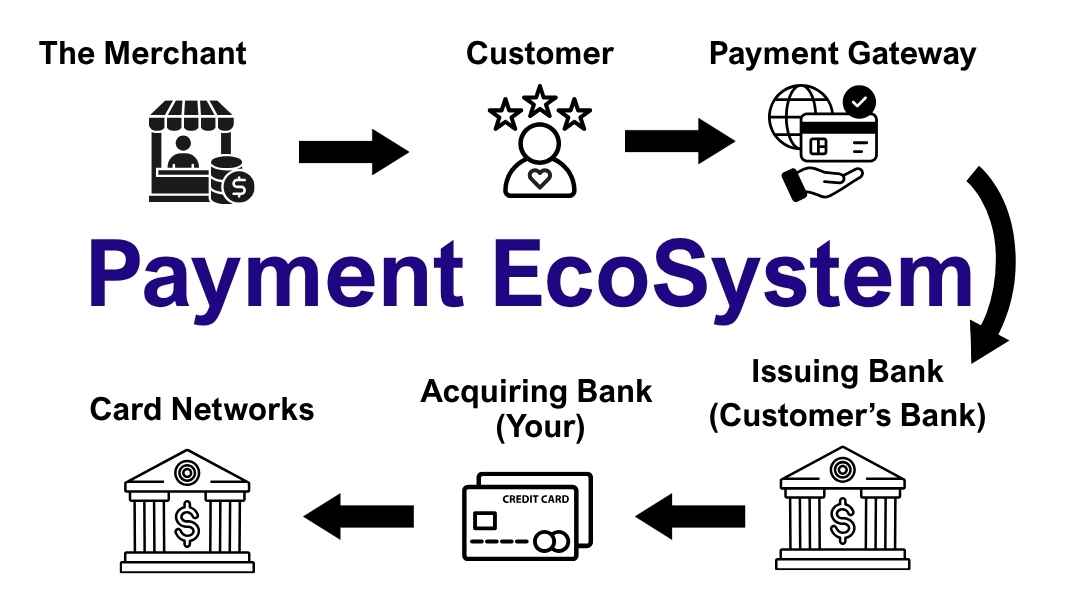
Before we track the journey of a single dollar, we need to introduce the key players. Think of a transaction like a high-stakes, hyper-fast theatrical performance. If any actor misses their cue, the entire show grinds to an embarrassing halt.
Here is the lineup of who is who when analyzing how payment gateways work behind the scenes:
1. The Merchant (That’s You!)
You are the star of the show, the brave entrepreneur, the person waking up at 4:00 AM to keep the wheels turning. You provide the incredible products or services, build the digital storefront, and attract eager buyers. Without your drive, there would be no payments to process in the first place, and the rest of these actors would be out of a job.
2. The Customer (The Cardholder)
The individual initiating the transaction. They possess a credit card, debit card, or a smartphone digital wallet filled with hard-earned capital that they want to trade for your offerings. They want this process to be so fast they don't have time to feel buyer's remorse.
3. The Payment Gateway
The secure digital bridge. Think of the gateway as a hyper-secure digital courier or a terrifyingly efficient bouncer. Its primary job is to collect the payment information from the customer at check-out, encrypt it so hackers cannot steal it, and pass it along safely to the next link in the chain. It is the virtual equivalent of swiping a plastic card at a physical counter terminal.
4. The Payment Processor
The operational muscle. While the gateway passes the message, the payment processor executes the order. The processor routes the data between the merchant, the card networks, and the banks. If the gateway is the courier delivering the letter, the processor is the massive automated postal sorting facility making sure it goes to the right country.
5. The Acquiring Bank (Your Bank)
This is your business bank, also known as the merchant bank. The acquiring bank hosts your merchant account, receives approved funds from transactions, and makes sure your business balances stay healthy, happy, and accessible so you can pay your bills (and yourself).
6. The Card Networks
The massive data freeways. These are the giant global financial entities that manage the underlying credit card infrastructure. They act as global routing networks that connect the merchant’s bank to the customer’s bank. Think of them as the digital superhighways where payment data travels at the speed of light.
7. The Issuing Bank (The Customer’s Bank)
The customer’s financial institution. This bank issued the credit or debit card to the consumer. They are the ultimate arbiters of whether the transaction is allowed to go through. They check if the customer actually has enough money or credit limit, and verify that the transaction doesn't look like fraudulent activity.
Act II: The Two-Second Symphony (Step-by-Step)
Now that you know the cast, let’s watch them perform. When analyzing how payment gateways work behind the scenes, the entire process can be broken down into three distinct phases: Capture, Authorization, and Settlement.
Let’s trace a single transaction through the system to see exactly how payment gateways work behind the scenes in real-time.
+------------+ Encrypted Data +-----------------+
| Customer | -------------------------> | Payment Gateway |
+------------+ +-----------------+ | v
+------------+ Route & Verify +-----------------+
| Card Networks| <----------------------- |Payment Processor|
+------------+ +-----------------+ | v
+------------+ Approve / Decline
|Issuing Bank| ---------------------------+
+------------+ | v +-----------------+ |Merchant Account | +-----------------+
Phase 1: The Digital Handshake (Capture)
It all starts when your customer decides they cannot live without your product.
Step 1: The Order Submission. The customer navigates to your checkout page, types in their card information, and clicks the submit button.
Step 2: The Gateway Intervention. The moment that button is clicked, the payment gateway springs to life. It captures the card details directly from the user's web browser or mobile app.
Step 3: Advanced Encryption. The gateway immediately wraps the credit card details in a heavy-duty layer of encryption (such as Transport Layer Security or TLS). This transforms legible numbers into an unreadable string of chaotic code. Why? Because sending unencrypted credit card data across the open internet is the digital equivalent of driving an open convertible filled with stacks of cash through a crowded city square.
Phase 2: Asking for Permission (Authorization)
Once the data is securely bundled up, the gateway needs to figure out if the money actually exists.
Step 4: Passing the Baton. The gateway hands the encrypted transaction packet over to your payment processor.
Step 5: Routing to the Acquiring Bank. The payment processor sends the data to your acquiring bank, which then shoots it out onto the card network freeway.
Step 6: Knocking on the Customer's Door. The card network routes the authorization request directly to the customer's issuing bank.
Step 7: The Interrogation. The issuing bank asks three rapid-fire questions in milliseconds:
Is this card valid and active?
Does the account holder have enough available funds or credit to cover this specific amount?
Does this purchase pattern fit the customer's usual habits, or does it look like someone stole their identity to buy a pallet of luxury watches at 3:00 AM?
Step 8: The Verdict. The issuing bank generates a response code. If everything looks spectacular, it issues an approval code. If the account is short on cash or looks suspicious, it issues a decline code.
Step 9: Retracing Steps. The approval or decline code travels back along the exact same path: from the issuing bank, through the card network, to the processor, through the payment gateway, and back to your website frontend.
Step 10: The Big Reveal. Your checkout page updates. The customer sees a joyful confirmation message, and your inventory system triggers fulfillment.
All of that happens before your customer can even take a sip of water. This is truly how payment gateways work behind the scenes to keep commerce moving at lightning speeds.
Phase 3: Moving the Money (Settlement)
While the authorization phase happens in real-time, no actual money has changed hands yet. The customer has simply promised the funds, and the bank has verified that the promise is good. Now comes the part you care about most: getting paid.
Step 11: Batching. At the end of every business day, your system compiles all your approved authorizations into a single digital "batch." Your payment gateway sends this batch to your processor.
Step 12: Clearing. The payment processor forwards the batch to the card networks, which systematically request the approved funds from all the various issuing banks.
Step 13: The Payout. The issuing banks transfer the cash to the card networks, which route it to your acquiring bank. Your acquiring bank deducts any processing fees and deposits the remaining net balance into your merchant checking account.
Depending on your service provider, this settlement phase typically takes anywhere from 24 to 48 business hours. Understanding how payment gateways work behind the scenes during settlement helps you manage your business cash flow with total confidence.
Act III: Gateway vs. Processor — Clearing Up the Confusion
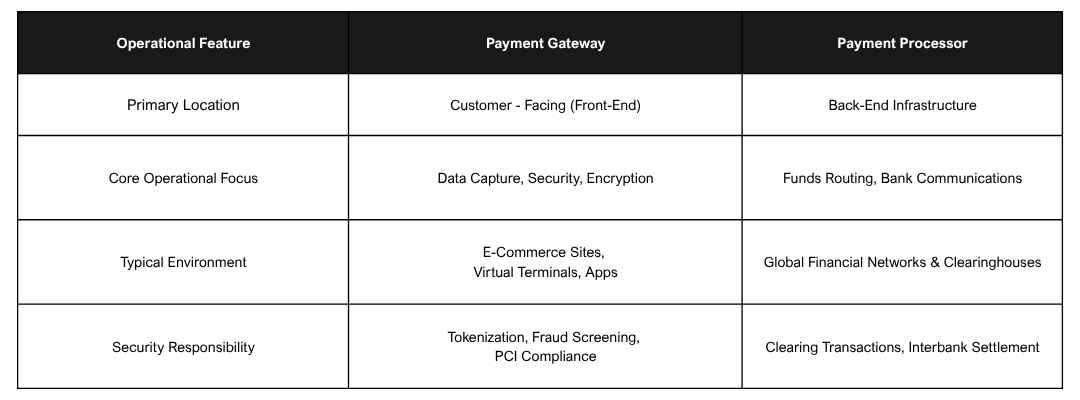
If your head is spinning trying to differentiate between a gateway and a processor, don't worry. You are definitely not alone. Even veteran e-commerce operators get these two concepts mixed up regularly. Let's break down the core differences using a simple restaurant analogy to understand how payment gateways work behind the scenes versus how processors handle the back-end labor.
Imagine your payment ecosystem is a fine-dining restaurant.
The Payment Gateway is your friendly, professional waiter. They stand at the front of the house, interact directly with the guest, write down the order details accurately, double-check that the table's demands make sense, and carry the ticket back out of sight into the kitchen.
The Payment Processor is the kitchen staff hidden behind closed doors. They don't talk to the guests. Instead, they do the heavy lifting, cook the food, coordinate with suppliers, assemble the ingredients, and ensure the final dish gets delivered efficiently.
To run a highly successful online business, you absolutely need both systems working in perfect harmony. When looking at how payment gateways work behind the scenes, remember that the gateway faces the consumer, while the processor faces the global banking network.
Here is a quick reference table to compare their distinct roles:
Act IV: The Critical Technology Keeping Hackers at Bay
When discussing how payment gateways work behind the scenes, we cannot ignore the elephant in the digital room: security.
Because online transactions take place without physical cards present (known in the industry as Card-Not-Present or CNP transactions), they are prime targets for cybercriminals. If a gateway had weak defenses, hackers could intercept transaction data and steal thousands of credit cards an hour.
To prevent this nightmare scenario, modern gateways deploy three cutting-edge defensive shields:
1. Advanced Tokenization
Tokenization is the gold standard of modern payment security. When a customer inputs their credit card number, the payment gateway immediately replaces that highly sensitive number with a randomly generated string of alphanumeric characters called a "token."
The real credit card number is stored deep within an incredibly secure, off-site digital vault. The token is the only thing that travels across networks during processing. If a hacker intercepts the transmission, all they steal is a worthless piece of randomized text. This tokenization process is a massive part of how payment gateways work behind the scenes to protect your merchant liability.
[Customer Card: 4111 2222 3333 4444] │ ▼ (Gateway Vault)
[Tokenized String: AX987-QP21-LM45-99B7] │ ▼ (Sent across public internet)
2. Point-to-Point Encryption (P2PE)
P2PE ensures that from the exact millisecond a card is swiped or typed into a device, it is thoroughly encrypted all the way through its journey to the final processing bank. The merchant never sees, stores, or handles raw card data, which heavily insulates your business from expensive liability risks and data breaches.
3. Integrated Fraud-Scrubbing Tools
Great gateways do more than just pass data; they analyze it on the fly. Built-in fraud detection tools scrutinize every single transaction against sophisticated indicators:
Velocity Checks: Is someone trying to use five different cards on your store within two minutes?
Geolocation Matching: Is the customer’s IP address coming from one continent while their billing address is registered on another?
Device Fingerprinting: Does the computer making the purchase have a history of fraudulent activity across other web stores?
By stopping suspicious activity before it reaches the authorization phase, understanding how payment gateways work behind the scenes allows you to dramatically reduce chargebacks and keep your merchant accounts in excellent standing.
Act V: Deep Dive into Alternative Payment Methods
As technology evolves, the way people want to pay changes too. A truly modern gateway doesn't just process standard credit cards; it handles an entire universe of alternative payment methods (APMs). To fully appreciate how payment gateways work behind the scenes, we need to look at how they handle things like digital wallets, buy-now-pay-later (BNPL) options, and direct bank transfers.
Digital Wallets (Apple Pay, Google Pay)
Digital wallets have taken over the world because they eliminate the need for customers to dig through their real-world wallets to find a piece of plastic. When a customer uses a digital wallet, how payment gateways work behind the scenes changes slightly.
Instead of capturing raw card details, the gateway receives a pre-encrypted token directly from the customer's device. This token often includes biometric verification (like FaceID or a fingerprint check). This makes digital wallet transactions incredibly secure and lightning-fast to process, lowering your abandonment rates at checkout.
Buy Now, Pay Later (BNPL)
BNPL services have exploded in popularity, especially among younger demographics. They allow customers to split their purchase into interest-free installments while you, the merchant, still get paid the full amount upfront.
When a customer selects a BNPL option, the payment gateway routes the transaction to the BNPL provider rather than a traditional credit card network. The provider approves the financing in real-time, pays you through your processor, and takes on the risk of collecting the remaining installments from the customer.
ACH and Direct Bank Transfers
Sometimes, credit cards aren't the best tool for the job—especially for business-to-business (B2B) transactions or high-ticket service contracts. That's where ACH (Automated Clearing House) or direct bank transfers come in.
When processing an ACH payment, how payment gateways work behind the scenes involves capturing bank routing and account numbers instead of card details. The gateway routes this data to the banking system to pull funds directly from the customer's checking account. While ACH processing can take a few days longer to settle than credit cards, the processing fees are usually significantly lower, making it an excellent option for large balances.
Act VI: The Hidden Costs of Processing Payments
Let's talk about the aspect of payment processing that every merchant thinks about but loves to hate: fees. Whenever money moves through the digital ecosystem, everyone who touches it takes a tiny bite out of the apple. To truly grasp how payment gateways work behind the scenes, you must understand where your processing money actually goes.
When you see a processing charge on your monthly statement, it is usually broken down into three main buckets:
1. Interchange Fees
This is the largest portion of your processing costs. Interchange fees are set by the card networks and are paid directly to the customer's issuing bank. They are designed to cover the bank's risk of lending money and managing the account. Interchange fees vary wildly based on the type of card used (a basic debit card costs much less to process than a premium airline rewards credit card).
2. Assessment Fees
Assessment fees are paid directly to the card networks themselves for the right to use their global financial freeways. These fees are usually a tiny percentage of your overall transaction volume and are non-negotiable.
3. Markup Fees
This is the fee charged by your payment processor and payment gateway for their software, security features, and operational support. This is the only component of your processing costs that is flexible and dependent on the provider you choose.
Understanding how payment gateways work behind the scenes regarding fee structures empowers you to negotiate better rates and choose a transparent provider that won't surprise you with hidden costs at the end of the month.
Act VII: How to Choose the Perfect Financial Technology Partner
Now that you know exactly how payment gateways work behind the scenes, you are well-equipped to evaluate providers for your growing enterprise. Do not make the mistake of choosing a provider based solely on a flashy ad campaign. Instead, analyze these five critical pillars:
1. Developer-Friendly Integration
Your gateway needs to seamlessly connect with your existing website, shopping cart, or point-of-sale software. Look for systems that offer robust Application Programming Interfaces (APIs), extensive documentation, and pre-built plugins for popular e-commerce platforms. The smoother the setup, the faster you can open your digital doors.
2. Bulletproof Security Architecture
Ensure any gateway you consider maintains full Payment Card Industry Data Security Standard (PCI DSS) Level 1 compliance. This ensures your software utilizes the absolute highest tier of security testing and validation available in the industry.
3. Comprehensive Multi-Currency Support
If your business dreams extend past national borders, your technology must follow. A world-class gateway allows international shoppers to view pricing and pay in their native currency, while automatically handling conversion mechanics before delivering your domestic currency directly to your merchant account.
4. Transparent, Predictable Fee Models
Payment tech pricing shouldn't require an advanced degree in mathematics to decode. Avoid providers who mask their true costs with convoluted tier structures or hidden maintenance penalties. Demand clear, honest, predictable fee models so you can accurately forecast your operational overhead and preserve your profit margins.
5. Around-the-Clock Support Engineers
When a payment system experiences an unexpected glitch at 2:00 AM during a peak holiday sales weekend, you do not want to talk to an automated chatbot that keeps sending you links to irrelevant help articles. You need access to live, knowledgeable human technical experts who can diagnose processing bottlenecks and restore your revenue pipelines immediately.
The Invisible Engine of Your Enterprise Success
While your customers may never look twice at the checkout page after they complete a purchase, you now understand the breathtakingly complex ballet of data and security happening right beneath the surface.
From the initial secure encryption click to the final settlement deposit into your business checking account, your payment gateway works tirelessly behind the scenes to minimize purchase friction, defeat fraud networks, and accelerate your cash flow.
By partnering with a robust business financial service provider that offers modern payment processing solutions tailored specifically to your unique industry vertical, you can stop stressing about transaction mechanics and refocus your energy entirely on what you do best: building an extraordinary, profitable brand.
_______________________________________________________________________
Let us know if you're looking for a gateway...we have access to several of them and they all have their own strengths and weaknesses. Let us find the one that works for you with the features that will help make your life easier. We'd love to work with you.