What is The Difference Between Interchange and Processor Fees
Welcome to the intricate (and occasionally bewildering) world of payment processing! If you’ve ever looked at your monthly merchant statement and felt like you were trying to decipher an ancient, tax-related dialect of Elvish, you aren’t alone.
As a merchant, you aren't just selling a product or a service; you are navigating a financial ecosystem. At the heart of this ecosystem lies a constant tug-of-war between two main types of costs: interchange fees and processor fees. Understanding the difference between interchange and processor fees is the secret sauce to optimizing your overhead and making sure you aren't leaving money on the table.
What on Earth is an Interchange Fee?
Think of the interchange fee as the "wholesale" cost of a credit card transaction. It is the base price set by the card networks (the big names you see on the plastic in your wallet).
When a customer taps their card at your terminal, a digital handshake happens between your bank and the customer’s bank. The customer's bank (the issuing bank) takes on a bit of risk by fronting the money and dealing with potential fraud. To compensate them for this risk and the cost of processing the data, they charge an interchange fee.
Who Sets These Rates?
Here is the kicker: you can’t negotiate these. Neither can we. These rates are non-negotiable and are updated twice a year (usually in April and October). They are the same for every processor in the country. If a processor tells you they have "special access" to lower interchange rates, they’re probably also trying to sell you a bridge in a desert.
Why Do They Change?
The interchange fee isn't a flat number. It’s a moving target based on:
Card Type: A basic debit card is cheap. A "Super-Mega-Ultra-Platinum-Rewards" card is expensive because someone has to pay for those airline miles (spoiler: it’s the merchant).
Transaction Method: Swiping a card in person is seen as low risk. Typing a card number into a website is "Card-Not-Present" (CNP), which carries a higher risk of fraud and, therefore, a higher fee.
Business Industry: A grocery store has different rates than a high-end jewelry boutique. The higher risk the market (Cannabinoids, Peptides, Gun Shops, etc) the higher the rates.
Enter the Processor Fees: The "Markup"
If interchange is the wholesale price, the processor fee is the systems fees. These fees cover the cost of customer support, technology, and build the security that keeps your data safe.
Unlike interchange fees, processor fees are where the variability happens. This is the part of your bill that depends entirely on which company you choose to partner with and which pricing model you select.
What Does the Processor Fee Cover?
Technology: The gateway, the physical terminals, and the encrypted networks.
Service: 24/7 support when your terminal decides to take an unscheduled nap on a busy Saturday.
Security: Staying compliant with PCI standards and fighting off the digital bandits.
The Showdown: How They Compare
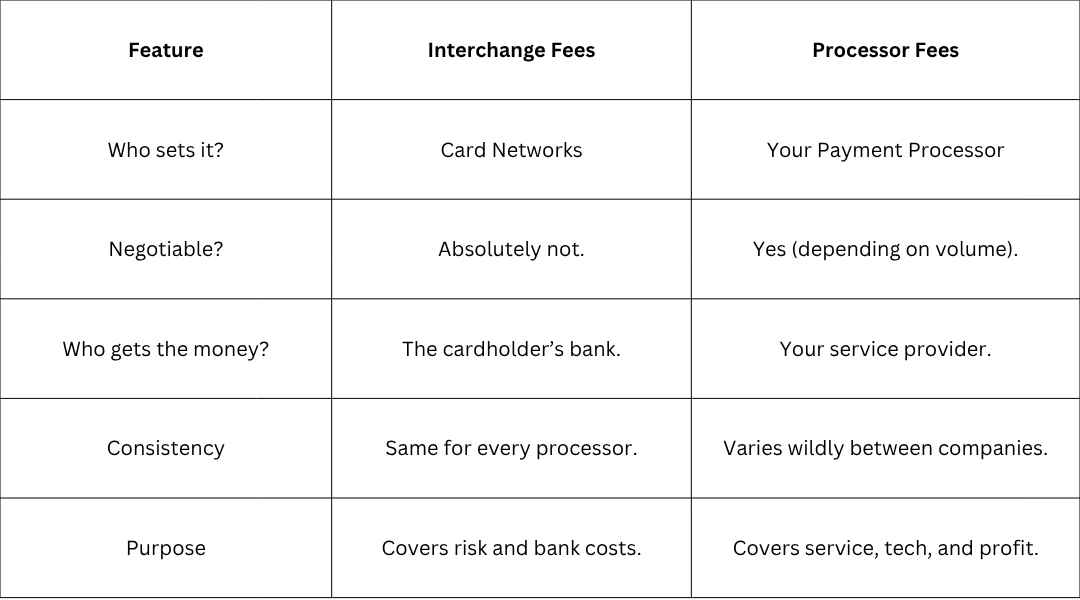
To truly grasp the difference between interchange and processor fees, let’s look at them side-by-side.
Pricing Models: How You See These Fees
Understanding the difference between interchange and processor fees is only half the battle. You also need to know how they appear on your bill. There are three common ways processors "package" these costs:
1. Interchange Plus (The Transparent Choice)
This is the "tell-it-to-me-straight" model. The processor passes the exact interchange cost to you and adds a small, flat markup (a processor fee). It is widely considered the most honest way to price, as you see exactly what the banks are charging versus what your processor is taking.
2. Flat-Rate Pricing (The Simple Choice)
You pay one flat percentage for everything. Whether it’s a low-cost debit card or an expensive rewards card, you pay, say, 2.75%.
The Pro: It’s predictable.
The Con: You are likely overpaying for simple debit transactions to "subsidize" the expensive cards. It is typically more expensive over all for merchants
3. Tiered Pricing (The "Hidden" Choice)
Transactions are bundled into "Qualified," "Mid-Qualified," and "Non-Qualified" buckets. While it looks cheap on paper, most transactions end up in the "Non-Qualified" bucket, which carries much higher fees. This model often blurs the difference between interchange and processor fees, making it hard to see where your money is actually going.
Why Understanding This Saves You Money
When you understand that the interchange fee is a fixed cost, you can stop fighting the "un-fightable" and focus on the processor markup.
Imagine you are buying a gallon of milk. The farmer needs a certain amount to survive (Interchange). The grocery store adds a bit to cover their rent and staff (Processor Fee). If the store charges you $10 for a gallon of milk, you don’t get mad at the cow; you find a store with a more reasonable markup.
By identifying the difference between interchange and processor fees on your statement, you can tell if your processor is being a fair partner or if they’ve added so many "convenience" and "statement" fees that you’re essentially paying for their CEO’s next yacht.
Summary for the Savvy Merchant
Navigating financial services doesn't have to be a headache. To wrap it up:
Interchange is what the banks charge. It’s the same for everyone.
Processor Fees are what your provider charges for their services.
Transparency (Interchange Plus) is usually your best friend for long-term growth.
Understanding the difference between interchange and processor fees empowers you to ask the right questions. Next time you speak with a processing representative, don't just ask "What's your rate?" Ask "What's your markup over interchange?" It shows you mean business—and that you've done your homework.
We would love to walk you through your options for payment processing!