The Risks of Not Following PCI Compliance
Imagine running a bustling retail store, an elegant boutique, or a booming e-commerce platform. Your inventory is stocked, your website is pristine, and customers are lining up with credit cards in hand. Now, imagine a single, devastating email arriving in your inbox that puts a sudden, screeching halt to your entire payment processing operation. No more swipes, no more taps, no more online checkouts. Your revenue drops to zero overnight, and your morning coffee suddenly tastes like liquid regret.
This nightmare scenario is not the plot of a corporate thriller; it is the reality facing business owners who overlook the Payment Card Industry Data Security Standard (PCI DSS).
When you run a business that accepts credit cards, data security cannot be treated as an optional checkbox, a boring chore, or something to "get around to next quarter" when things quiet down (spoiler alert: they never do). It is the structural foundation of your daily transactions. Yet, many merchants treat cybersecurity like a gym membership—something they pay for, think about occasionally with a twinge of guilt, but rarely utilize properly. Unfortunately, skipping security guidelines carries penalties far more severe than a bit of skipped cardio and a soft midsection.
Understanding the risks of not following PCI compliance is essential for any merchant who wishes to survive and thrive in a digital economy. Non-compliance is not a minor administrative oversight like forgetting to refill the office water cooler. It is an open invitation to cybercriminals, financial auditors, and regulatory bodies to dismantle the business you have spent years building. Let's dive into exactly what happens when you play fast and loose with cardholder data, and how you can protect your hard work without losing your sanity.
Defining the Baseline: What is PCI DSS?
Before diving into the chaotic, shark-infested waters of non-compliance penalties, let us establish what this standard actually is. The Payment Card Industry Data Security Standard was established by the major global payment card brands to ensure that all companies processing, storing, or transmitting credit card information maintain a secure environment. Think of it as a mutual agreement to not leave the digital front door wide open with a sign that says "Free Money Inside."
PCI compliance applies to every single merchant who accepts card payments, regardless of business size or transaction volume. Whether you process three transactions a month out of a weekend food truck or three million transactions a week through an international online marketplace, the rules apply to you. There is no "get out of jail free" card just because you run a cozy mom-and-pop shop.
Compliance is scaled across four distinct merchant levels based on transaction volume:
Level 1: Merchants processing over 6 million card transactions annually. (The titans of retail.)
Level 2: Merchants processing between 1 million and 6 million transactions annually.
Level 3: Merchants processing between 20,000 and 1 million e-commerce transactions annually.
Level 4: Merchants processing fewer than 20,000 e-commerce transactions annually, or up to 1 million total real-world transactions.
Many small-to-medium business owners fall squarely into Level 4, which leads to a dangerous, comforting misconception: "I'm too small for hackers to notice, and too small for regulators to care. They’re after the big fish."
In reality, data shows that small businesses are the primary targets for digital theft precisely because they frequently ignore security protocols. Hackers do not always hunt for the massive corporate whale with a team of fifty cybersecurity guards; they are often perfectly content catching hundreds of unprotected small merchant fish who left their passwords set to "Password123." When it comes to the risks of not following PCI compliance, size does not protect you—good habits do.

The Compounding Risks of Not Following PCI Compliance
When a business chooses to put off its data security obligations, it sets off a domino effect of financial, operational, and legal consequences. Let us examine the specific vulnerabilities and penalties that define the risks of not following PCI compliance.
1. Escalating Monthly Non-Compliance Fees
The most immediate and predictable consequence of failing to validate your security protocols is the appearance of annoying monthly penalty fees on your merchant statement.
Payment processors are required to monitor the compliance status of their merchants. If your business fails to submit its annual Self-Assessment Questionnaire (SAQ) or fails its mandatory quarterly network vulnerability scans, your processor will label your account as non-compliant.
This status triggers immediate monetary penalties. Initially, these fines might look relatively minor—perhaps $50 to $100 per month labeled as a "PCI Non-Compliance Fee" on your processing statement. It’s easy to look at that and think, "Eh, I'll pay the hundred bucks and worry about it later." However, these fees are structured to escalate over time to compel action. They are the financial equivalent of your processor nagging you to clean your room, and the volume gets turned up every month.
If non-compliance persists past three months, those penalties can jump drastically. For mid-sized and larger operations, acquiring banks can pass down monthly penalties ranging from $5,000 to $100,000 per month until compliance is fully restored and validated. For a small business, paying hundreds or thousands of dollars extra each month simply for ignoring a security assessment is an entirely preventable waste of capital that could have gone toward inventory, marketing, or a much-needed team holiday party.
2. The Nightmare of a Data Breach
While monthly fees are annoying, they pale in comparison to the catastrophic impact of an actual data breach. When you disregard security standards, you leave major gaps in your payment architecture. Common compliance failures include:
Improper Data Storage: Retaining cardholder name, primary account number (PAN), expiration dates, or sensitive CVV codes in plain-text spreadsheets, local text files, or unencrypted local databases. If a hacker gets in and finds an Excel sheet named "Customer_Credit_Cards.xlsx," you have essentially done their homework for them.
Weak Access Controls: Allowing multiple employees to use shared, generic login credentials to access point-of-sale (POS) systems or backend databases without multi-factor authentication (MFA). If everyone is logged in as "Cashier1," it is impossible to know who did what.
Outdated Software Patches: Failing to regularly update your operating systems, firewall rules, and e-commerce plugins. Leaving known software vulnerabilities wide open is like knowing your back door lock is broken and deciding to fix it "eventually."
Unmonitored Networks: Operating point-of-sale terminals or online checkouts without continuous logging or network monitoring, allowing suspicious activity to go unnoticed for months while digital thieves quietly drain data.
When cybercriminals exploit these vulnerabilities, they harvest your customers' financial data. The immediate aftermath of a data breach involves chaotic containment efforts, taking payment systems offline, and hiring external cybersecurity teams to find out how the attackers got in. Your business operations grind to a painful, expensive halt while you try to put out the digital fire.
3. Exorbitant Forensic Investigation Costs
If your business experiences a suspected or confirmed data breach while operating outside of security guidelines, you cannot simply patch the hole, say "our bad," and go back to business as usual. The payment card networks will mandate a formal Payment Card Industry Forensic Investigation (PFI).
A PFI must be conducted by an independent, certified forensic examiner. The goal of this investigation is to determine exactly how the breach occurred, how many cardholder records were compromised, and whether the merchant was actively violating security requirements at the time of the incident.
Here is the catch: the entire cost of this forensic investigation is placed solely on your business.
+--------------------------------------------------------------+
| TYPICAL FORENSIC AUDIT EXPENSE BREAKDOWN |
+--------------------------------------------------------------+
| - Forensic Examiner Retainer Fees |
| - System Log Analysis & Data Preservation |
| - Infrastructure Remediation Costs |
| - Mandatory Post-Breach Quarterly Re-Audits |
+--------------------------------------------------------------+
| TOTAL TYPICAL COST OUT-OF-POCKET: $20,000 to $100,000+ |
+--------------------------------------------------------------+
For a small merchant, an unexpected $30,000 forensic bill can instantly wipe out annual profit margins. For larger enterprises, these comprehensive investigations easily scale into six-figure expenses. It is an incredibly expensive way to find out that you should have updated your security software six months ago.
4. Per-Record Breach Penalties and Card Replacement Fees
Once the forensic investigation concludes, the financial bleeding continues. The card brands will levy fines based on the sheer volume of data exposed.
When a database is compromised, the penalties are applied per exposed record, not per customer. If an attacker extracts a database containing historic transaction logs where a single customer has ten distinct transaction entries, that can count as multiple exposed records. These breach penalties typically range from $50 to $90 per record. Do the math quickly, and you will see how fast a minor slip-up turns into a financial avalanche.
Furthermore, when credit card data is stolen, banks must proactively cancel those compromised cards and issue brand-new physical plastic to consumers to prevent fraud. The card issuing banks will pass the cost of printing, manufacturing, and mailing those replacement cards directly back to the non-compliant merchant who allowed the data to leak. At roughly $5 to $15 per replaced card, a breach involving just 5,000 customers can easily generate a massive, unexpected bill that lands squarely on your desk.
5. Crushing Legal Liability and Class-Action Lawsuits
We live in a highly litigious society where people love to sue. When consumers discover that their personal financial data was compromised because a business failed to follow basic, industry-standard security practices, they do not just get angry—they call attorneys.
Operating in a state of non-compliance provides plaintiffs with immediate ammunition. It demonstrates a clear lack of "reasonable care" in protecting consumer information. It’s hard to defend your business in court when the prosecution can prove you ignored the basic safety standards established for your industry.
Merchants face a barrage of legal challenges following a breach:
Consumer Class-Action Lawsuits: Affected customers band together to sue for damages, identity theft protection services, and emotional distress.
B2B Breach of Contract: If you act as a vendor, supplier, or service provider for other businesses, your corporate clients may sue you for damages if your system breach disrupts their supply chain or compromises their own corporate networks.
Merchant Bank Lawsuits: Your acquiring bank or payment processor may launch legal proceedings to recoup the massive operational losses they suffered while resolving your security mess.
Defending against a single corporate lawsuit requires massive legal retainers, hundreds of billable hours, and months of stressful depositions, dragging your focus entirely away from running your actual company and growing your sales.

6. Severe Reputational Damage and Loss of Consumer Trust
Money can eventually be earned back, but consumer trust is incredibly fragile. Once lost, it is nearly impossible to rebuild.
Modern data privacy regulations require businesses to notify customers explicitly if their personal or financial data has been compromised. This means you will be forced to send a formal email or physical letter to your entire database explaining that your digital defenses failed and that their information might be floating around on the dark web.
Imagine the conversation your customers will have when they receive that notice. They will stop looking at your brand as a helpful service provider and start looking at it as an existential threat to their personal bank accounts.
┌─────────────────────────┐ │ Data Breach Discovered │ └────────────┬────────────┘ │ ▼ ┌─────────────────────────┐ │ Mandatory Notifications │ └────────────┬────────────┘ │ ▼ ┌─────────────────────────┐ │ Customers Flee to │ │ Compliant Competitors │ └────────────┬────────────┘ │ ▼ ┌─────────────────────────┐ │ Long-Term Revenue Drop │ └─────────────────────────┘
In highly competitive industries, customers will simply cross the street or click over to a competitor who guarantees a secure checkout. They won't risk their financial safety for loyalty. The long-term loss of recurring revenue from a damaged reputation is frequently the final blow that drives non-compliant businesses into permanent bankruptcy.
7. Complete Revocation of Credit Card Processing Privileges
If you think monthly fines and bad press are the worst-case scenario, consider the absolute ultimate penalty: losing your merchant account permanently.
Payment card networks and merchant acquiring banks are risk-averse institutions. They have zero desire to partner with a business that acts as a continuous liability to their financial ecosystem. If a merchant repeatedly ignores compliance warnings, refuses to fix security gaps, or suffers multiple breaches due to persistent negligence, the financial institution will terminate their processing agreement.
Without a merchant processing account, you cannot accept Visa, Mastercard, American Express, or Discover. For an e-commerce storefront, this means your business is effectively dead in the water. For a brick-and-mortar storefront, you are forced to revert strictly to cash or check, instantly alienating the vast majority of modern consumers who rely entirely on digital wallets, smartwatches, and plastic. Good luck running a modern enterprise on paper bills and pocket change.
8. Landing on the Dreaded MATCH List
To make matters worse, when an acquiring bank terminates a merchant due to security failures or excessive unaddressed risks, they do not just wave goodbye and let you walk down the street to open an account with a different processor. Instead, they place your business and your personal information onto the MATCH list.
MATCH stands for Member Alert to Maintain Frequent Silence (historically referred to as the Terminated Merchant File or TMF). Think of it as the ultimate blacklist for commercial payment processing. It’s the business world equivalent of being banned from every restaurant in town at the same time.
Once your business name, corporate tax ID, and personal owner information are logged in the MATCH database, it follows you everywhere. Every reputable payment processor checks this list during the underwriting phase for new accounts. Finding your name on this list tells underwriters that you are a high-risk liability.
Landing on the MATCH list effectively bans you from obtaining standard merchant processing services for up to five years. While some boutique, ultra-high-risk processors might agree to take you on, they will demand exorbitant processing rates, hold massive cash reserves, and enforce restrictive monthly volume caps that stifle your ability to grow. It is a financial chokehold that most businesses simply do not survive.
Technical and Operational Differences: Compliance vs. Non-Compliance
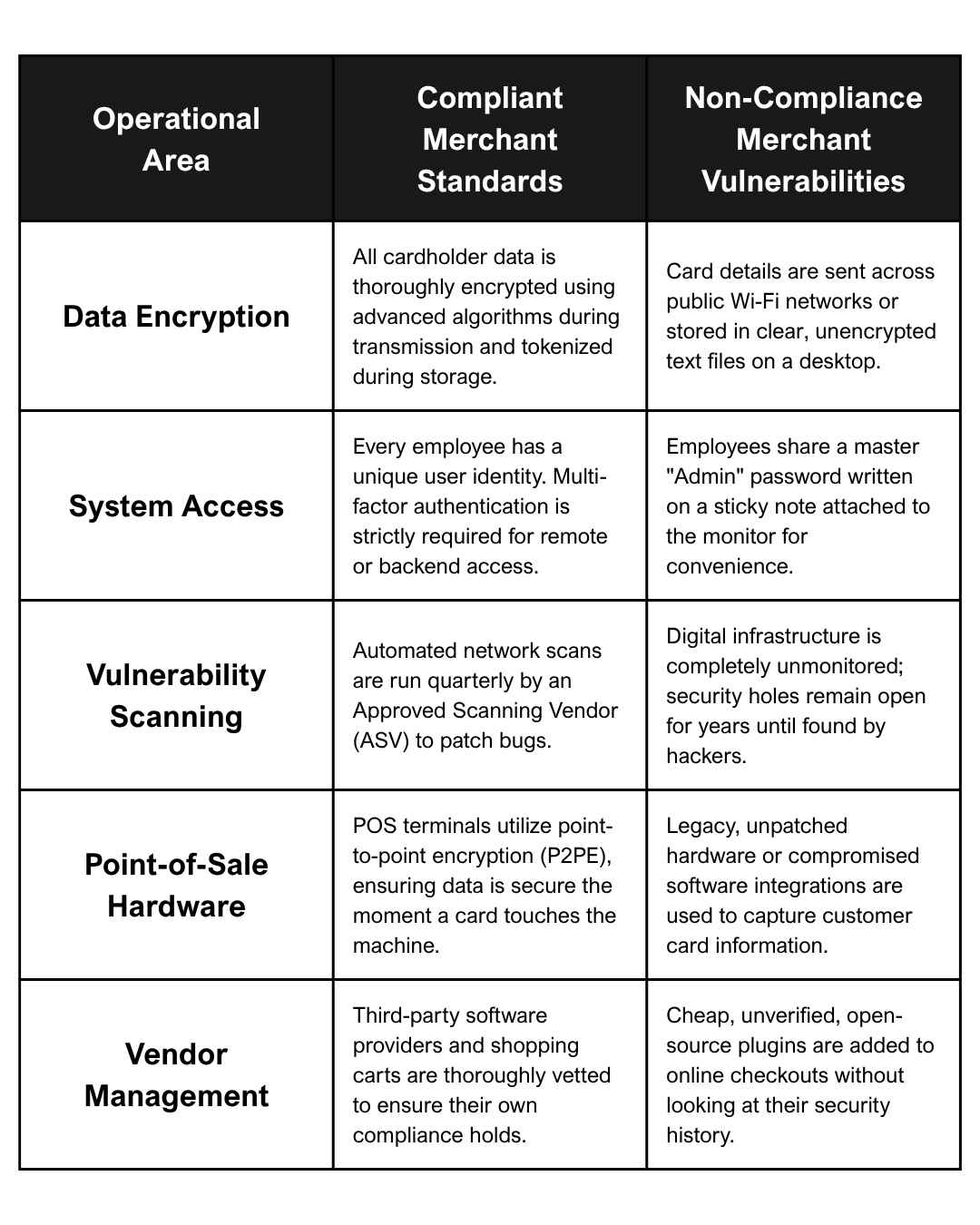
To visualize how deeply these vulnerabilities run throughout an organization, let us compare how a compliant merchant operates versus how a non-compliant merchant exposes themselves to daily operational peril. It’s the difference between an organized, locked fortress and a house made of cardboard with a welcome mat out front.
Proactive Steps: How to Protect Your Business
Now that we have analyzed the severe financial, legal, and operational damage associated with ignoring payment card safety standards, let us focus on practical, stress-free solutions. Reaching and maintaining a valid security posture does not require you to hold a master's degree in cybersecurity or spend your weekends learning how to code. It requires a structured, intentional approach to data management.
Step 1: Determine Your Exact Validation Track
Your very first objective is to understand which Self-Assessment Questionnaire applies to your specific business model. The PCI Security Standards Council offers several variations of the SAQ based on how you accept payments, so you don't have to answer questions that don't apply to you:
SAQ A: Designed for e-commerce or mail/phone-order merchants who have completely outsourced all cardholder data functions to validated third-party service providers. Your website never physically touches, processes, or stores the card data; it is safely redirected to a secure payment gateway page. This is the simplest validation track and a favorite for small online shops.
SAQ A-EP: For e-commerce merchants who utilize a website that influences the consumer's payment path, even if the actual data is sent to a third-party processor. This requires more extensive technical scans.
SAQ B-IP: For brick-and-mortar merchants utilizing standalone, IP-connected point-of-sale terminals that do not store electronic cardholder data.
SAQ D: The most comprehensive and exhaustive questionnaire, designed for any merchant who stores, processes, or transmits cardholder data directly on their local servers. It’s the heavy-lifter of the compliance world.
By consulting with a knowledgeable financial services provider, you can align your operations with the correct SAQ, saving your team weeks of unnecessary paperwork, administrative confusion, and pulled-out hair.
Step 2: Implement Point-to-Point Encryption (P2PE)
One of the most effective methods to drastically reduce your compliance burden is to adopt hardware and software solutions that utilize validated Point-to-Point Encryption.
When a customer swipes, inserts, or taps their card on a P2PE-validated terminal, the sensitive card data is instantly scrambled and encrypted directly inside the hardware device before it ever enters your local network, computer systems, or routers.
Because your local network never sees or touches unencrypted credit card data, the vast majority of your network infrastructure is completely removed from your compliance scope. This turns a complex, multi-page technical security audit into a quick, straightforward checklist. It’s the ultimate shortcut to keeping data safe without changing how you do business.
Step 3: Partner with a Qualified Payment Professional
You do not have to manage data security completely on your own, nor should you have to spend your evenings reading security compliance manuals. The most successful merchants protect their revenue by partnering with an experienced, transparent business services company that specializes in modern payment processing and integrated financial solutions.
A dedicated processing partner does not just hand you a card reader, collect their fees, and wish you luck; they provide the comprehensive tools, secure gateways, and expert support needed to streamline compliance validation effortlessly. They help automate your quarterly scanning schedules, guide your team through annual SAQ submissions, and ensure your payment ecosystem is continuously updated against emerging digital threats.
Professional Graphic Concepts for Design Teams
To maximize the visual layout and scannability of this article, a design team can construct custom, high-end infographics or featured images based on the professional design blueprints below. These visual assets avoid generic corporate cliches and focus directly on structured data presentation with clean, engaging visual cues.
Concept 1: Featured Image Blueprint (Article Header)
+-----------------------------------------------------------------------+
| [ BACKGROUND LAYER ] |
| - Deep, dark slate blue gradient with an abstract, faint digital |
| matrix or interconnected security node pattern. |
| |
| [ FOREGROUND LEFT: TYPOGRAPHY ] |
| - Bold, clean, sans-serif headline in crisp white: |
| "THE COST OF NEGLIGENCE" |
| - Accent sub-headline in a vivid, professional orange or crimson: |
| "The Real Risks of Not Following PCI Compliance" |
| |
| [ FOREGROUND RIGHT: VISUAL ELEMENT ] |
| - A stylized, minimalist 3D rendering of a credit card emerging |
| from a secure digital shield that has fractured, glowing cracks, |
| symbolizing an exposed network perimeter. |
+-----------------------------------------------------------------------+
Concept 2: The Non-Compliance Penalty Lifecycle (Infographic)
[ PHASE 1: THE OVERSIGHT ] │ - Merchant misses the annual validation deadline or ignores warnings. ▼
[ PHASE 2: IMMEDIATE MONETARY FRICTION ] │ - Non-compliance fees range from $50 to hundreds of dollars monthly. ▼
[ PHASE 3: THE EXPOSURE POINT ] │ - Unpatched software vulnerabilities allow a data breach to occur. ▼
[ PHASE 4: FORENSIC INVESTIGATION ] │ - Mandatory independent PFI audit fees cost tens of thousands. ▼
[ PHASE 5: REVENUE LIQUIDATION ] │ - Class-action lawsuits, per-record penalties, and card reissue costs. ▼
[ PHASE 6: OPERATIONAL HALT ] │ - Processor terminates the merchant account; business is blacklisted on MATCH.
Concept 3: Data Security Architecture Comparison (Infographic)
+-------------------------------------+-------------------------------------+
| THE UNPROTECTED NETWORK | THE SECURED SYSTEM |
+-------------------------------------+-------------------------------------+
| [!] Plain-Text Card Storage | [✓] Multi-Layered Tokenization |
| Data visible in local files. | Data replaced with safe tokens.|
| | |
| [!] Shared Admin Passwords | [✓] Unique User Accounts + MFA |
| Zero internal tracking. | Strict identity confirmation. |
| | |
| [!] Legacy Outdated POS Software | [✓] Validated P2PE Terminals |
| Open to known exploit scripts.| Instant hardware encryption. |
+-------------------------------------+-------------------------------------+
Protecting What Matters Most
At the end of the day, data security is not about satisfying an abstract board of auditors, making regulators happy, or filling out complex technical questionnaires just to avoid a small monthly penalty. It is about protecting the long-term viability of your business, safeguarding your hard-earned professional reputation, and honoring the trust your customers place in your brand every single time they hand you their payment cards.
Ignoring the risks of not following PCI compliance is the financial equivalent of leaving your physical storefront wide open overnight with the keys left directly inside the front door lock and a neon "open" sign flashing. The digital world presents real threats, but it also provides highly effective, easy-to-use defenses.
Take a close look at your current merchant processing environment this week. Review your monthly processing statements for hidden non-compliance penalties, audit your internal data access policies, and make sure your team uses secure, encrypted payment architecture. Partnering with a professional financial services company ensures your business stays fully protected, giving you the complete peace of mind needed to focus entirely on driving sustainable business growth and keeping your customers happy.
__________________________________________________________________________________
Need help getting PCI compliance? Or being reminded when to do it? We help. We will walk you through the process.